

Macroeconomic Strategy Team
7 October 2022
A period of slowing growth
Investors hoping for a return of Goldilocks-like trading conditions are likely to find themselves disappointed in the coming months. In our view, the global growth picture—which will be reflected in the trading environment—appears set to deteriorate through the rest of 2022 and to remain weak in the first half of 2023.
Much of current market commentary seems overly focused on whether the global economy or a specific region will slip into recession. We’ve always felt that such a binary “will it, won’t it” framing isn’t helpful. What’s more important is how quickly we’re likely to enter a period of very slow growth and how long it will last. In our view, we could be looking at between four and six quarters. For context, we do expect the United States, Canada, and Europe to slip into recession next year: Stagflationary dynamics—which have been amplified by Russia’s invasion of Ukraine—remain at play and make for a challenging backdrop for risk assets.
Stagflationary dynamics could persist until the end of 2022, YoY (%)
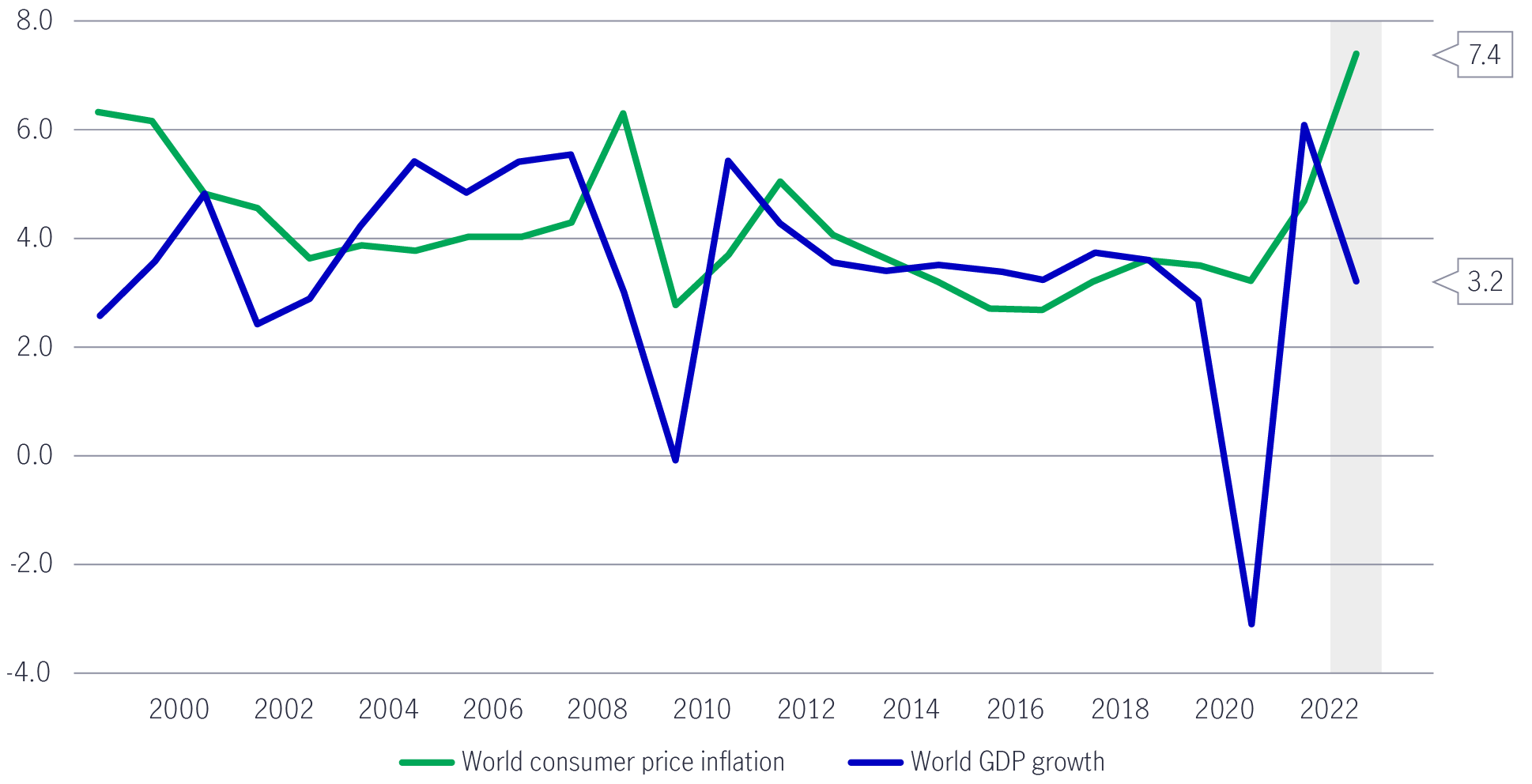
Source: Bloomberg, Macrobond, Manulife Investment Management, as of September 15, 2022. YoY refers to year over year. The gray area represents a recession.
Macro anchors that could shape risk markets in the coming months
1 Slowing growth in China
The economic costs of the country’s dynamic zero-COVID policy mount as the fear of additional large-scale lockdowns persists. Slowing global growth would also likely mean a reduction in global appetite for Chinese exports.
2 Inflationary pressures should ease, but inflation is likely to remain elevated
Inflationary pressures should unwind gradually over the coming months, but they’re likely to remain at elevated levels through the rest of 2022 and into next year.
3 Central bank tightening as a headwind to growth
Global central bank tightening in both developed markets and emerging markets will contribute to deteriorating global liquidity conditions and act as a headwind to growth.
A challenging few months ahead
In our view, the prognosis is clear: We’re entering a challenging period for risk markets, in the short term at least. The broader geopolitical environment doesn’t help, as two important events—the Chinese Communist Party Congress in October and the U.S. mid-term elections in late 2022—will no doubt dominate market chatter. In times like these, it’s important to consider enhancing portfolio resilience. While it’s true that opportunities can emerge in times of uncertainty and volatility, it’s just as important for investors to cut through the white noise in the near term and train their goals on the longer term.
2026 Global healthcare equities outlook: Innovation supports healthcare’s long term case
Global healthcare equities showed resilience amid 2025 volatility. The defensive characteristics, coupled with remarkable therapeutic innovations in the biopharmaceutical, MedTech, and tools sub-segments of this sector, will continue to be rewarded with capital appreciation over a full market cycle. Current valuations relative to the broader market make for an attractive entry point today, and periods like this tend to lead to outperformance for healthcare stocks over the long term.
Semiconductors poised for long-term growth amid AI boom
The global semiconductor industry remains strong – arguably the most robust we have seen in over three decades. This strength is supported by cutting-edge innovation, rising revenues and robust capital spending. While risks remain, the outlook for 2026 appears constructive, with demand for artificial intelligence (AI) applications showing few signs of slowing. Beyond AI, the non-AI markets could be poised for positive revisions as cyclical recovery gains traction after several years of consolidation.
2026 Outlook: Clearer picture, better growth
This year’s outlook spotlights a world in flux – U.S. stimulus, Europe’s rebound, China’s policy pivots, and Japan’s innovation surge all shape a landscape full of both opportunities and challenges.

© 2026 Manulife Investment Management. All rights reserved.


